A Quote Is Not the Whole Source
A quote is not the whole source: learn what quotations and paraphrases preserve, what they leave out and how to check a claim against its original context.

What can a quotation really tell you about what someone said? A quote is not the whole source: it is a selected fragment, while a paraphrase is a reporter’s account of the meaning. Each can preserve useful evidence, and each can leave important details behind. Reading them well means asking not just whether the words appear accurate, but what surrounding material would change how you understand them.
A quotation preserves wording, not the whole exchange
Quotation marks make a strong promise: the words inside them are being presented as the speaker’s words. That lets readers inspect phrasing for themselves. A hesitant “I think we can proceed” does not sound quite like “We can proceed”, even if both might be compressed into the same general point in a paraphrase.
But quotation marks do not show what came before, what followed, or how the question was framed. A short excerpt may omit a qualification, a correction or a change of subject. The words can be exact and still give an incomplete impression of the speaker’s position.
Consider a hypothetical council briefing. An official says, “We can begin the work if the inspection confirms the site is ready.” A report quotes only “We can begin the work”. Those words are present, but the condition that governs them has disappeared. The quote is accurate as a fragment and misleading as a standalone account.
When reading a quotation, check whether the sentence contains a condition, contrast or limit. Words such as “if”, “unless”, “but” and “only” often carry more of the claim’s meaning than its most memorable phrase.
Paraphrase preserves a claim by changing its form
A paraphrase gives the substance of a statement without claiming to reproduce its exact wording. It can help readers follow a long, technical or meandering answer. A reporter might describe the council official as saying the work could start only after an inspection, making the condition visible without reproducing every spoken word.
That compression requires judgement. The reporter must decide which ideas are central, how to express them plainly and how much qualification to retain. A paraphrase can therefore preserve the structure of an argument more clearly than a clipped quotation, but it also places the reporter’s wording between the source and the reader.
Notice the difference between “the official said the work could start after inspection” and “the official approved the work”. The first keeps a condition; the second may suggest a completed decision. Neither sentence uses direct quotation, so the reader cannot assess the original phrasing from that line alone. The surrounding report should make clear whose account is being presented and what supports it.
Paraphrase is not a licence to make a source sound more certain, more decisive or more consistent than the full statement warrants. Look for whether the report keeps the speaker’s limits, degree of confidence and distinction between a possibility and a decision.
Each form answers a different reading need
Direct quotation is most useful when the wording itself matters: a disputed phrase, a carefully qualified answer, a notable change in tone, or a statement whose exact terms readers may want to judge. It can also show how a person expresses an idea, rather than only what a reporter says the idea was.
Paraphrase is often more useful when the answer is long, repetitive or full of specialist language. It can bring the main point into focus and avoid turning a report into a transcript. A well-chosen quotation and a fair paraphrase can work together: one lets readers hear the source’s voice, while the other explains the broader point.
The forms are not rivals in a contest over authenticity. A quote offers access to selected wording; a paraphrase offers an interpreted summary. Neither, by itself, establishes whether the underlying claim is true. A person can be quoted exactly while making an unsupported assertion, and a careful paraphrase can accurately report that assertion without verifying it.
Ask what kind of evidence the sentence supplies: the source’s wording, the source’s broader meaning, or evidence for the claim itself. Those are related, but not interchangeable.
Context reveals what the excerpt cannot show
Context is not simply a larger block of text. It is the material that helps establish what a statement referred to and what limits applied. For an interview, that may include the question, the answer immediately before the quoted line, a qualification later in the exchange or an explanation of the subject under discussion.
For a written source, check whether the article links to a speech, report, filing or statement. If it does, compare the relevant passage with the account in the story. Look for a change in scope: a source may be discussing one location, group or stage of a proposal, while the report’s paraphrase appears to describe a broader situation.
Context also helps distinguish a person’s conclusion from the facts they cite. “The inspection found no damage” reports a finding; “the building is safe” may be a broader conclusion. If a quote or paraphrase moves from one to the other, look for the evidence that supports that move rather than assuming the two claims mean the same thing.
You do not need to hunt down a full transcript for every sentence. Start with the detail that could alter the meaning: a condition, the question asked, the relevant scope or the source document behind the claim.
Attribution shows who is responsible for the wording
In a quotation, the speaker is responsible for the quoted wording, while the publication is responsible for selecting and presenting it. In a paraphrase, the source remains responsible for the underlying position, but the journalist is responsible for the summary’s wording and fairness.
Attribution helps readers track those roles. “The department said the site was ready” identifies the department as the source of the claim; it does not, by itself, confirm readiness. “The site was ready” presents the point as an unqualified statement. If the article gives no basis for that broader assertion, the shift in attribution matters.
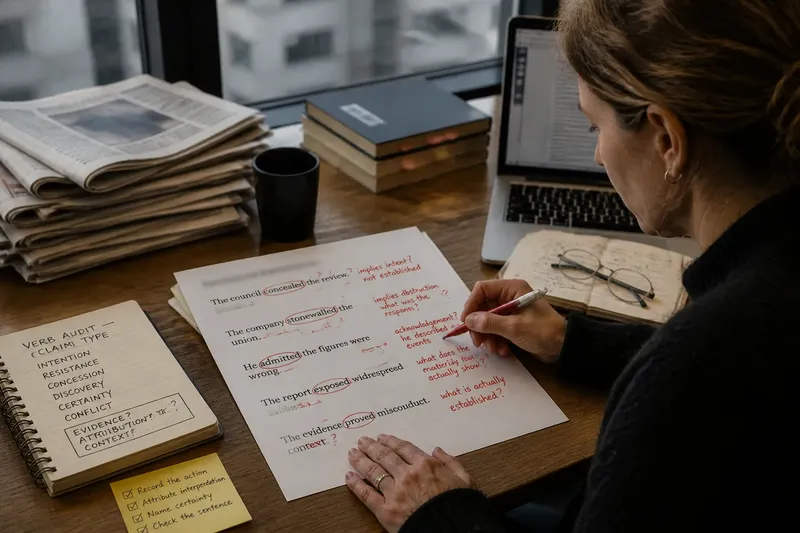
Pay attention to verbs such as “said”, “argued”, “estimated” and “confirmed”. They describe different relationships between a source and a claim. “Said” reports that a statement was made; “estimated” signals an approximate judgement; “confirmed” implies a stronger status that should be supported by the account. The wording around a quote can therefore shape its force as much as the excerpt itself.
When several people or documents are involved, identify which one supports each part of the sentence. A source may speak to what was planned, while another provides evidence about what happened. A report that blends both into one smooth line can be hard to assess unless the attribution stays visible.
Check what a quote or paraphrase can support?
Does the quotation keep the qualification?
Read around the quoted words and look for conditions, exceptions or corrections. If a nearby phrase changes whether the speaker meant “will”, “might” or “only if”, the excerpt is not a complete account of the position.
Does the paraphrase preserve the speaker’s level of certainty?
Compare the summary with the source’s apparent confidence and scope. A tentative forecast should not become a firm promise, and a limited observation should not turn into a general conclusion without additional support.
Can you locate the source behind the account?
Look for a named speaker, document, interview or other identifiable origin. If the report provides a link, use it to check the relevant passage; if it does not, the article may still be reporting accurately, but the reader has less material for an independent comparison.
What evidence supports the underlying claim?
Separate the fact that someone made a statement from the truth of what they said. Look for the records, observations or other attributed evidence the report offers, and note when the article leaves a claim unresolved.
A careful reading compares the sentence with its job
Imagine a hypothetical local report about a bridge inspection. Its paraphrase says that engineers found a fault that needs attention, followed by a direct quote: “We have not determined whether it affects the crossing.” The paraphrase tells readers what was identified; the quote preserves a clear limit on what is known. If the article instead uses a short quote about the fault without the uncertainty, the reader may mistake identification for a judgement about its consequences.
In that situation, check the inspection document or the fuller attributed account for what was examined and what remains undecided. The useful question is not simply, “Is this quote exact?” It is, “Does the report show the difference between the finding and the conclusion readers might draw from it?”
This is the broader lesson behind A quote is not the whole source: evaluate the excerpt against the claim it is being used to support. Exact wording can clarify a position, while a paraphrase can make its shape easier to follow. Read both for what they preserve, check the context that could change their meaning, and keep the reported statement distinct from the evidence for it.